HONEYCRUSH: BRUTALITY, TRUTH, AND FOLK HORROR ROCK
By Good Call Music
Alexandra Antonopoulos on finding her sound, confronting uncomfortable truths, and the making of her debut album, Backwards Crawling Speaking Stalling.
Photo: dimitry mak
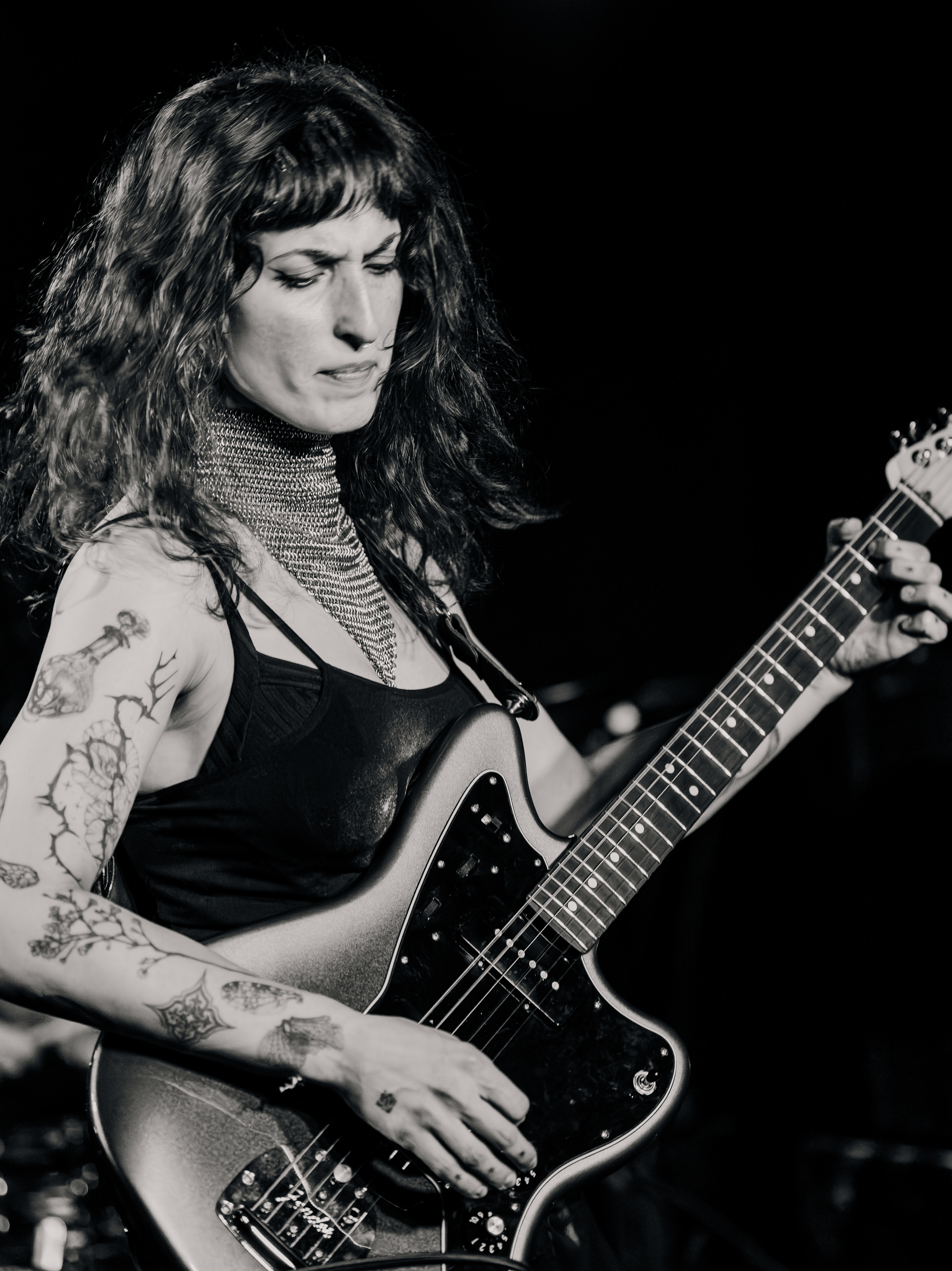
Brooklyn-based singer-songwriter Alexandra Antonopoulos, better known as Honeycrush, makes what she calls “folk horror rock,” a dark, atmospheric mix of alt-rock, folk, and post-punk built around heavy guitars and her haunting, powerful vocals.
Her debut album, Backwards Crawling Speaking Stalling, is the culmination of four years of experimentation, self-discovery, and unlearning the rules of her classical vocal training. Recorded in Ridgewood, Queens, the album explores growing up, confronting uncomfortable truths, and finding your way through a world that can feel increasingly hostile.
“I like brutality and asymmetry and truth,” she says, a philosophy that runs through the record's raw, emotionally charged songs.
We caught up with Alexandra to talk about the meaning behind “folk horror rock,” overcoming the fear of sharing her music, her songwriting process, and the experiences that shaped her debut album.
You describe your sound as “folk horror rock.” What does the horror part mean to you, and how does it find its way into the music?
Well, “folk horror” is my favorite genre of everything — photography, movies, books — and it’s usually based in a rural setting where there is suspicion of the outside world or “others” and the setting is eerie and dangerous. I love a sense of impending doom, mystery, suspense and the natural world and my music takes cues from those things. When I wrote “My Dog” I wasn’t thinking about any kind of labels, it was just a fun song that I wanted to make sure felt unsettling and rough with a beautiful, lamenting vocal layer on top. When I made the video for it, it took on a life of its own because I edited it in a way where you think you might be seeing something then it cuts to black. Then again, something intriguing — cut to black. I don’t do shock or gore to try to scare people, the “horror” part comes from the “folk horror” ambience of the music and you could say as well the horror of being a woman in a world ruled by men. We’re fighting through very dark times when it comes to women’s safety and bodily autonomy, to say nothing of the resurgence of the “trad” mindset. I write about that horror a lot.
Photo: dimitry mak
What do you remember about making your first recordings at home? When did you start to hear something that felt like your own sound?
I was crying a lot because I was so scared to share music I was making with the outside world! I was really locked down within myself and didn’t feel like I would ever allow myself to try and potentially fail at making music. I felt like I could do it but I was scared of judgment. It’s really vulnerable to make something up and share it but when I would get excited and scared by a melody or rhythm, I knew I was going down the right path.
You also write poetry. Does your songwriting usually start with lyrics, or does each song take a different path?
I sometimes get a phrase or a string of words that will pop into my head and I’ll either write it down or just keep playing with it until it finds its place in a song or a song title. There are a thousand ways to begin writing a song but most often I’ll play the guitar until I hear something that intrigues me and then I’ll chase down the idea. I’ll feel spaces for phrasing that are very obvious and then it’s almost like the words are buried under dirt and I’m digging them up and brushing them off. There’s a certain amount of “finding” the lyrics and a certain amount of writing them. First I look for the shape, then I can make choices, but the shape of them isn’t negotiable; the words that fit there are.
Photo: dimitry mak
What’s been the biggest change in your life between releasing Milk Teeth and finishing Backwards Crawling Speaking Stalling? How does that show up in the music?
I made an EP called Dogwoods that was my first time recording in a studio. I was very tense because I wasn’t used to the workflow or dictating ideas to people and also it was February and the studio was really cold. But that record had a song on it called “My Dog,” which has since really found its audience and it was also the largest body of work I’d released at that point. Dogwoods came out in May 2025, I quit my previous full-time job in January 2026 and focused as much energy as I could into promotion, writing, learning, practicing, touring, and lost a lot of money but learned a lot of things. I think my songs have better dynamics in them now. It’s been a few years of moving at a breakneck pace and now I’m trying to find time and ways to slow down, because that isn’t sustainable. I’ve had a lot of momentum since Milk Teethand I’ve learned so much.
What’s the story behind the title Backwards Crawling Speaking Stalling? When did you know it was the name for your debut album?
BCSS is the story of a second puberty, like when you really grow up and become an adult, not when you’re biologically an adult. I feel like it’s a stumbling, fumbling exercise in forward motion that knocks you down and turns you around but you have to keep going, even if you’re tripping and your clothes are getting stuck on branches while you push ahead. The songs are a lot about seeing the world and people as they really are, in my interpretation, which is cynical at times and often reveals a cruelty in humanity, especially once you open your eyes to the sheer volume of men committing violence against women. There’s a current of mistrust that runs through it because, honestly, I trust the world so much less than I did even 10 years ago. It’s about understanding yourself, too, and accepting yourself and the generational circumstances you’ve been dealt. I’m fascinated by repeating patterns, especially those that repeat across generations, so there’s some exploration of that in there as well.