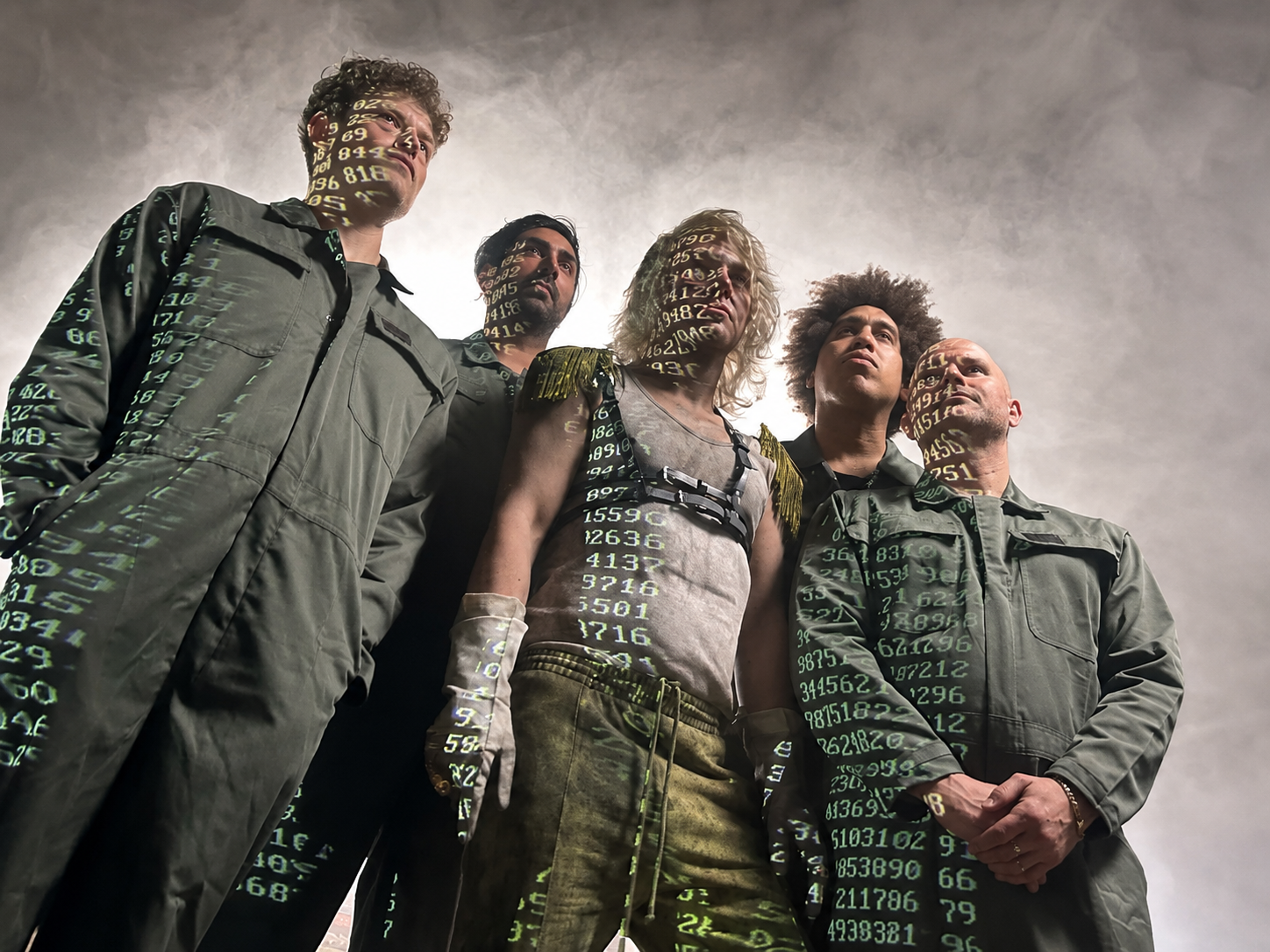
The Blood Brothers found a new generation. Evil Island found a new reason to make music
Evil Island wasn’t supposed to be the next chapter of The Blood Brothers. But after the band’s 2024 reunion put Johnny Whitney, Cody Votolato and Mark Gajadhar back in the same orbit, the energy didn’t simply disappear when the shows ended. Instead, it became the starting point for something new.
Joined by Autry René Fulbright of OFF! and …And You Will Know Us by the Trail of Dead, and later Todd Weinstock of Glassjaw, Evil Island quickly took shape. Early demos turned into a full band, Ross Robinson came on board, and their debut album, Terraform the Afterlife, was born. Out August 14 via Robinson’s Blowed Out Records, the album reconnects the musicians with a producer whose history with The Blood Brothers stretches back more than two decades. It also features a remarkable appearance from Fugazi’s Guy Picciotto on “T-Hexx,” his first recorded vocal performance since The Argument.
For the members of Evil Island, though, this isn’t about recreating what came before. It’s about what happens when people with decades of history find themselves making music together again from a completely different place in their lives.
Good Call spoke with Evil Island about walking away from music and finding a way back, becoming a band almost by accident, working with Robinson again, getting Picciotto behind a microphone, The Blood Brothers’ influence on a new generation, and why hardcore and post-hardcore feel especially vital right now.
Thank you for doing this! Before we get to Evil Island, Johnny, you essentially stepped away from music for a long time. What did your life look like during those years, and did you think you were done making music for good?
Johnny: I stopped playing music in 2010 when I was 29 because I was very burnt out from touring since graduating high school and couldn’t handle being broke anymore. I wanted to figure out another career before it was too late to make a big change. I spent about a year really struggling to find work because A. I had no work experience or degree and B. there was a global economic collapse and all the money in the world was on fire.
I spent about a year doing odd jobs like washing dishes and DJing people’s weddings before one of my oldest friends offered to let me intern as a software engineer at his web development company. It was terrifying and I knew 0 about software engineering. Once I got the hang of it a little bit I started to really enjoy the challenge and the problem solving element of it and devoted myself 1000% to teaching myself as much as I possibly could in the shortest amount of time possible.
From 2010–2012 I pretty much lived on adderall and beer and stayed up for days in a row working and teaching myself how not to suck at writing code. During this time in Seattle there was a huge talent vacuum for software engineers and I was able to really use that to my advantage and BS my way into a lot of jobs that I really needed to fake it till I made it.
I bounced around to a couple of different companies including Amazon and finally landed a really solid role at Netflix in 2015. I’ve been working at Netflix ever since. I really did think I was done making music for good. I thought if I ever wanted to do something creative again I’d go in a different direction like doing stand-up or starting a podcast or something like that.
Did Evil Island grow out of the energy around The Blood Brothers reunion shows? How quickly did it go from an idea to “we’re actually starting a band”?
Cody: We finished The Blood Brothers tour super excited and with a little ambiguity as to whether or not we were going to do anything else. It took a little time to sort that out, but once it was clear that it wasn't happening, Johnny called me and told me he wanted to do something. I had a batch of songs I had been working on that I thought were perfect for him. I sent him a bunch of demos, and he quickly had vocal ideas sent back to me.
Once we got Mark on board, we knew we could do something great. Shortly after that, I showed a couple of demos to Ross, and we had a deal with his label and a plan to go into the studio. I jammed with Autry a few times, then he was in. We jammed our first note as a "full band" in the studio with Ross. It became real there.
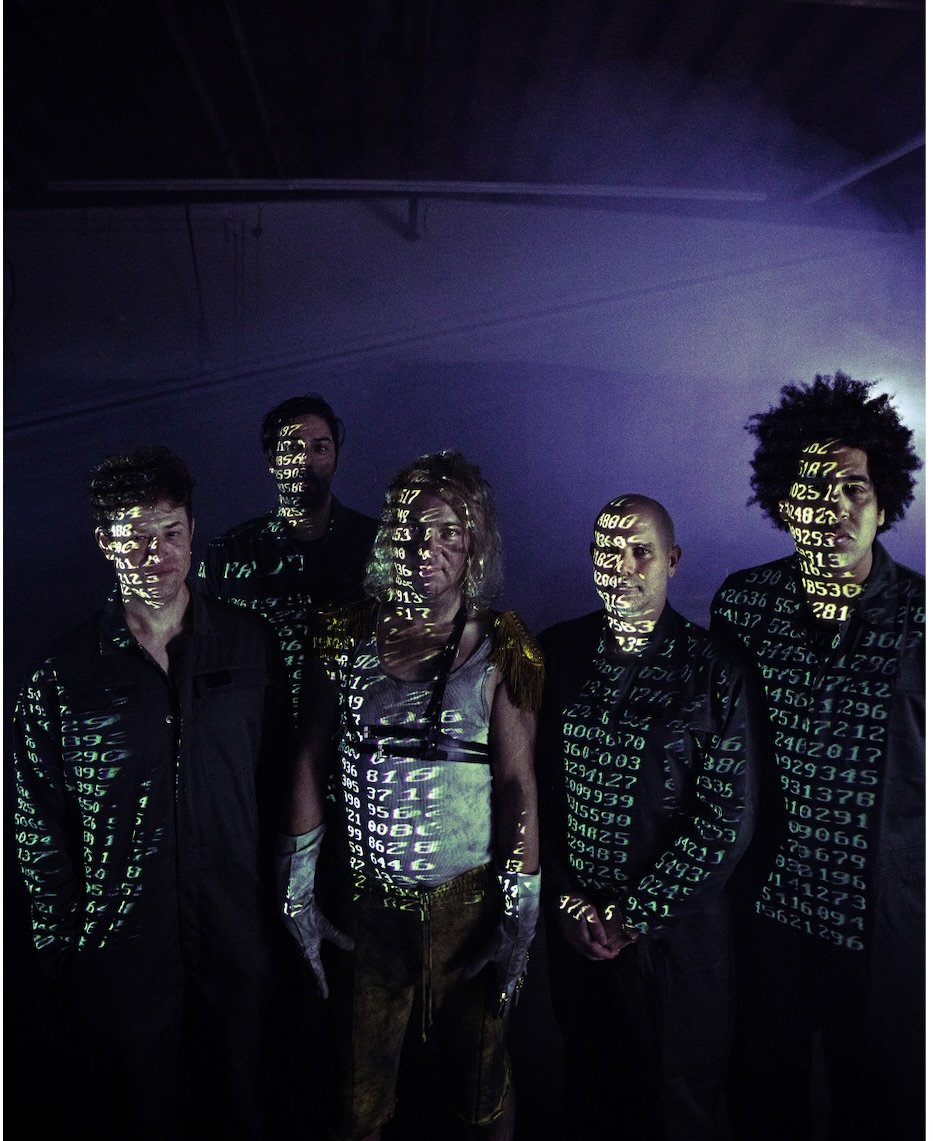
What’s the biggest goal you have for Evil Island right now? Will there be a lot of touring?
Johnny: Right now my biggest goal is to have the most amount of people humanly possible hear the record. I emphatically believe it’s the best piece of music I’ve ever worked on, and really the goal is just to spread it far and wide. I would love to tour and make more records with Ross more than anything.
Right now we are still in this liminal space where the record has not come out yet, we haven’t played any shows, and we are all just kind of holding our breath, waiting to see what happens when we are on the other side of the record coming out and everyone hearing what Evil Island is.
Three of you have The Blood Brothers history, but Autry comes in with his own history in OFF! and …And You Will Know Us by the Trail of Dead, and now Todd from Glassjaw is part of the live lineup. Did bringing them into the mix make Evil Island feel like something completely new?
Cody: For many years I was writing and creating music all on my own from top to bottom. Most of the skeletons of the songs on Terraform were written that way on the music side. It wasn't until Mark and Autry got their hands on them that they came to life. I truly believe that in order to have something truly special and unique, you need everyone in the room's touch. The happy accidents or simply a different perspective can send an idea to the moon.
Once we started playing the songs as a band in a room, the real magic started to happen. We were able to write new parts, deconstruct, change and build on the ideas. The coalescing of ideas isn't always easy, but I do believe it creates something that no other group of individuals than those in that room can create, and to me that is the most special way to make music.
I'm looking forward to getting into the next round of songs from start to finish as a whole group and with Todd in the mix.
You went back to Ross Robinson more than 20 years after making …Burn, Piano Island, Burn together. What’s different about working with Ross now—not just as musicians, but as people?
Cody: I've had the pleasure of making a handful of different records with Ross over the years since we did Burn, so for me it was a continuation of what I knew to be such a great experience. He and I really gel in the studio. I love his process and the way he knows how to coach you to get what is best out of you. I'm really able to let go of any ego when I'm in the studio with Ross and really trust him. I've also maintained a personal relationship with him all these years, and he is truly family. Everyone should get to record with him!!!
Johnny: For me, working with Ross was night and day from the Burn, Piano Island, Burn sessions. At the time we did that record, I was very anti-social and mostly kept to myself. I didn’t really let him into my headspace or my thought processes around the songs whatsoever. For Evil Island, it was the complete opposite. We spent so much time together talking about the songs, the lyrics, what went into our ideas, how we were feeling when we came up with the ideas… everything.
For my role, he had a 360-degree view of my entire thought process around every angle of every song. Because of how close we became, he knew exactly how to direct me when I was tracking all my vocals, and I think you can really hear that come through when you listen to the record.
Guy Picciotto sings on “T-Hexx,” his first recorded vocal performance since Fugazi’s The Argument. That is absolutely insane. You already knew Guy from him producing Young Machetes. How did you get him to sing on this record, and what was it like hearing his voice on one of your songs?
Cody: At first the idea seemed pretty unrealistic/unattainable, but as we talked more and more about it, we just sort of figured it wouldn't hurt to ask, so that's what I did. I gave him a call, told him about the new project and said we had a song in mind that we thought he would be perfect on. He said he was open to it and to send him the song. Once the tracks hit my inbox, I couldn't believe it. He sang the song and it was absolutely incredible. It still trips me out to hear him on the song and to hear him singing alongside Johnny. What a time to be alive!!!
Johnny: Hearing Guy sing alongside my voice was earth-shattering to my psyche the first time he sent over the first version. It felt like I was living in an alternate dimension. Besides the ghost of Kurt Cobain, there is not a single person I can think of that I would want to have sing on our record more than Guy.
Outside of music, what’s been inspiring you most lately?
Johnny: I’ve been pretty inspired writing and making sketch-adjacent videos for a good chunk of this year. I wrote the treatments for the Tiger Baby and Animal videos, and Mark and I have been making sketches for Evil Island for our social media. It’s been a really fun challenge for me because it is very out of my comfort zone, and it’s fun to get into a creative space that tickles different parts of your brain. Writing dialogue and visual sequencing is such a different set of mental muscles than writing lyrics and singing, but they complement each other in interesting ways.
Hardcore and post-hardcore feel like they’re in an incredible place right now. Young bands are coming up, older bands are finding new audiences, and the generations seem to be mixing together. Why do you think this scene feels so alive again right now?
Cody: The energy behind it creates a safe place for anyone who is drawn to the sound. I think this is why it can span across generations. People need a place to put their feelings, and hardcore/post-hardcore can absolutely serve as a conduit and a home for that.
Johnny: Hardcore and post-hardcore are profoundly personal expressions of art and creativity and also generally nest themselves in a community of actual human beings. It’s a very social art form at its root and is often a source of encouragement and positivity for the uninitiated. We live in a dark fucking time. People are generally lonelier and more disconnected and hopeless than in years or decades prior.
I think for a lot of people, hardcore and post-hardcore isn’t just music; it’s a balm on what would otherwise be a very sad and desperate existence and a source of positivity. I don’t think it’s an accident that all this happened after COVID and the years of loneliness and isolation that followed.
The Blood Brothers are influencing people who may have been kids—or weren’t even born—when those records originally came out. Has seeing that changed the way you think about the band’s legacy?
Cody: It definitely makes me proud!
Johnny: I didn’t really comprehend the scale of how many younger people had been influenced by The Blood Brothers until 2024, when we did our reunion tour. Every night I met people that came there with their parents. I even met a girl whose mom went into labor with her at one of our concerts in Oakland in 2004!
When we were touring all those years, if you could see from our POV, it was a really big struggle for us. We were always a little too weird to fit cleanly into the emo/hardcore scene and a little too extreme to fit into what people now refer to as “indie sleaze.” We were just The Blood Brothers, and people either loved us or wanted to skin us alive.
Seeing the legacy of The Blood Brothers’ music still alive and still inspiring young people made me really proud that, in a way, we never really fit in anywhere. We had to do our own thing because we were incapable of being anything else, and I have the perspective now to realize that this is really part of why it was special and is still relevant decades later.
Follow Evil Island at @evil.island.band
Photo Credits: Ross Robinson (Main) | Richie Valdez (Body)
Terraform the Afterlife cover by Ashey Watson